


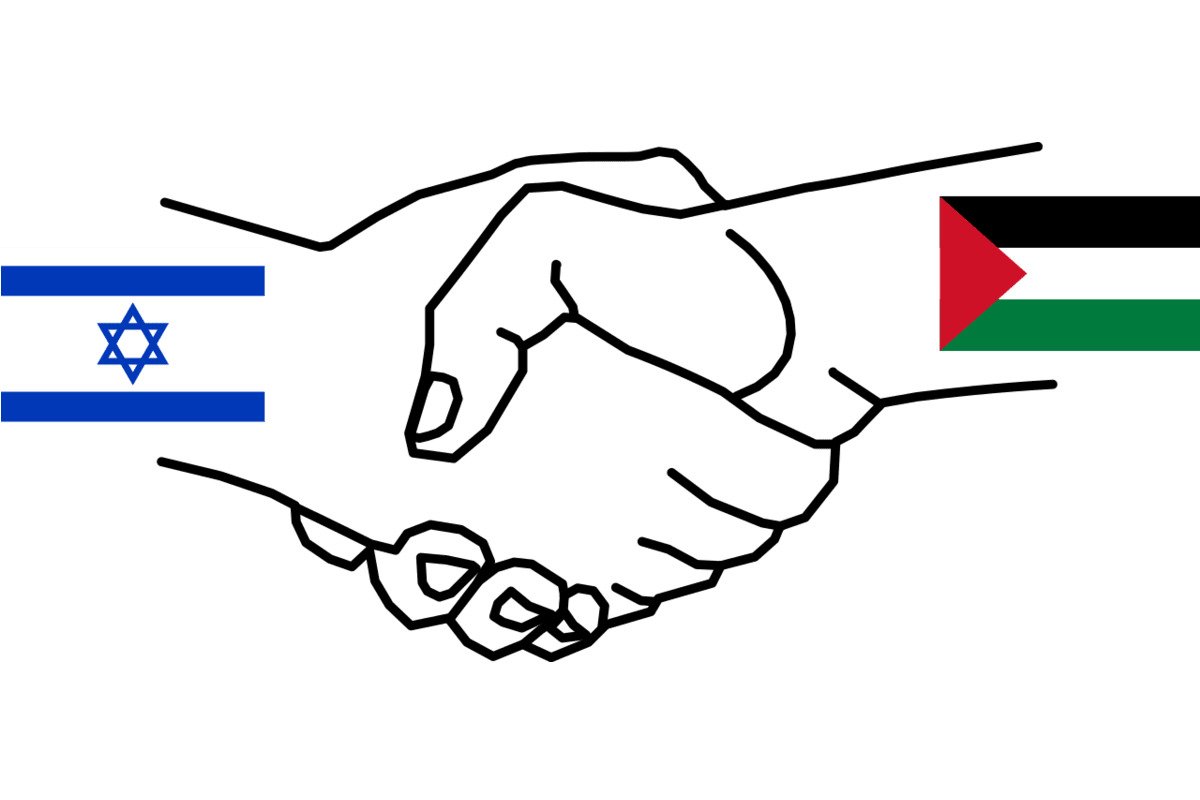
I am five months younger than the state of Israel. My Children’s Encyclopedia had a display of flags of the world, and I especially liked the cool blue and white of Israel’s flag, and the perfect symmetry of the Star of David.
That was the time of the Suez crisis in 1956, when my parents talked admiringly about little Israel’s David-and-Goliath victory over Egypt. At Sunday school we were doing the escape of the children of Israel from bondage. In my memory all those things seemed to happen together.
Things got conflicted for me in 1959 when ‘World Refugee Year’ was proclaimed by the United Nations. I read how Palestinian refugees had lost their homes and country when Israel was created in 1948. Even at the age of 11, I thought that couldn’t be right. In my teens, I started to learn about the bigger picture, the war of words over Israel and Palestine and the competing solutions. I read about the Palestinian resistance groups. I noticed that one of them, the Democratic Front for the Liberation of Palestine, had an interesting solution to the conflict. They advocated a secular democratic Palestinian state shared by Jews and Arabs equally. That sounded reasonable to me, despite their bombastic rhetoric. It would allow the refugees to go home, but retain a safe country for Jews. Surely the best option.
Israel and Palestine: a secular single state solution
Looking back, I think I saw the single state as a way of reconciling two conflicting moral principles. On the one hand I valued rights and legitimacy. But on the other I also valued survival, safety and well-being. I wanted to respect everyone’s rights and legitimate interests, but wondered how much human misery and destruction is justified by the defence of those rights. The displacement of the Palestinians in 1948 breached their rights on a massive scale, leaving a shadow over Israel’s legitimacy. But how to restore those rights without harming the Israelis? I believed the single state could achieve just that. And, I discovered, there was a model for that arrangement right next door. The republic of Lebanon, just north of Israel, had been created as a multi-confessional state with a balanced constitution protecting Christians, Sunnis, Shiites and others. If it could be done in Lebanon, surely it could be done in Palestine.
But as it turned out, it couldn’t be done in Lebanon. In 1975, the balance between Lebanese Christians, Shias and Sunnis broke down in 15 years of bloody civil war. Eventually peace returned, but Lebanon was wrecked and still struggles to function as a state. Two decades later Israel/Palestine’s other immediate neighbour, Syria, was likewise ravaged by civil war, also partly fought on confessional lines. The single shared state looked like a recipe for disaster in this neighbourhood. Far from being the best option, it was surely the worst. Trying to restore Palestinian rights by abolishing Israel in favour of a multi-confessional and multi-ethnic state risked another Lebanon or Syria, with death and destruction on a huge scale.
Status quo: the less bad option
For me, this became the strongest argument in favour of retaining the state of Israel.
Decades of chronic, low-level conflict have been utterly vile for millions of people, notably the Palestinians of the West Bank and Gaza, and the inhabitants of southern Lebanon. But if we take the present century and the fatalities resulting from Israeli-Palestinian conflict since 2000, one reputable estimate gives a figure of 11,985 deaths up until 7 October. These are both Israeli and Palestinian, though far more of the latter. During only half of that same period (starting in 2011) neighbouring Syria’s civil war has cost between 350,000 and 600,000 lives.
On that comparison, the status quo has seemed the less bad option for Israel/Palestine. It also allowed the possibility of squeezing in a Palestinian state alongside Israel, if only the Israelis could be persuaded to accept it. And even as that prospect has been slowly strangled, the less bad option has still looked better than any other.

Status quo destroyed
But that phase is now over. The situation that allowed me to believe in the less bad option ended with the Hamas attack on 7 October. The ferocity of that violence, and the Israeli violence that followed, has moved the dial from the less bad to the worst. The resultant death toll is well over 30,000 and at the present rate will soon be half of the death toll of the previous 75 years. And it looks quite possible that 1948 will repeat itself; that there will be a second expulsion of Palestinians from Palestine, this time from the Gaza Strip and the West Bank. If that happens, the legitimacy of Israel’s tenure in Palestine will be in tatters, just at a time when Israel looks more vulnerable than it has for years. It is impossible to see how the stalemate of recent decades – the less bad option – can be retrieved.
Reviving the two-state solution
Before 7 October, the two-state solution looked like a lost cause. Palestinian leaders and some others were moving back to the idea of a single state for Arabs and Jews together. But at present the only single state is Israel, and it is bombing a population toward whom it has responsibility for borders, power and water supplies, virtually a civil war.
Now western politicians are trying to revive the two-state solution. It still looks impossible, as Netanyahu is absolutely opposed to the idea. And yet. Through living a life-span contemporaneous with Israel’s, I have learned that dramatic change can happen even when things seem frozen. The collapse of the USSR taught me that (and it still astonishes me now!).
Israel’s freeze was smashed into fragments on 7 October, and perhaps things are still sufficiently fluid to change dramatically yet again. As to the direction of that change, we can only hope. Most of us hope for peace. But as to the form that peace should take ‒ I’m as conflicted now as I was in 1959.


