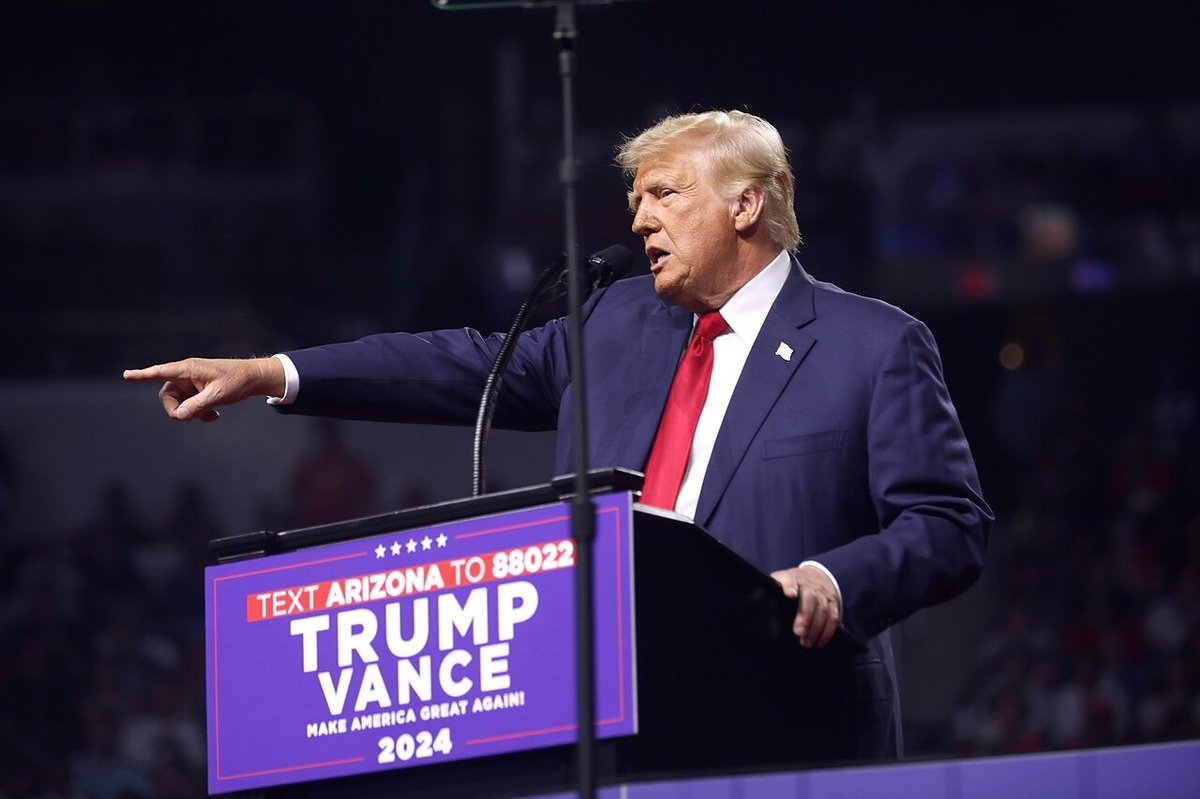
A week after Donald Trump was elected to his second term as president of the United States, three university academics held a symposium at the University of Lincoln to discuss the result.
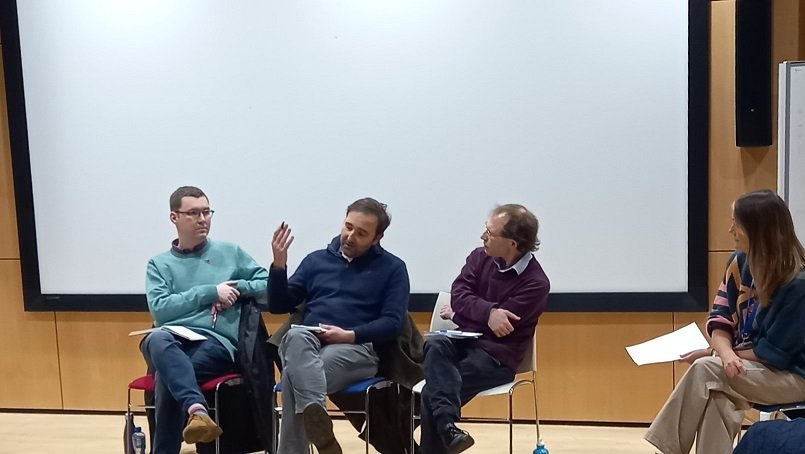
Dr Tim Galsworthy is a lecturer in History and Military History at Bishop Grosseteste University, Lincoln, with a focus on the Republican Party and the American Civil War.
Dr Mike Slaven is an Associate Professor and Programme Leader in the School of Social Sciences at the University of Lincoln. His special interests lie in the politics of immigration and security.
Dr Finn Pollard is an Associate Professor in American History, also at the University of Lincoln. He specialises in cultural representations of the USA.
The event was chaired by Professor Karen Savage, Head of Arts, Culture and Heritage in the College of Arts and was informally structured. Each academic offered their thoughts on the 2024 US election result and the audience was invited to ask questions.
2024 US election results: Donald Trump vs Kamala Harris
Media outlets were quick off the mark with their judgements once the result was known. The BBC called it “historic” and “a stunning political comeback“, while various US networks took a less measured view. First reactions to the result are always subject to revision however, and a week after the event, more reasoned analysis began to emerge.
Though the Electoral College numbers suggested the result was anything but close (312 for Trump, 226 for Harris), the reality was very different. Galsworthy said that, in historical terms, talk of a landslide was wildly over the top and Trump’s win ranked well down the table of electoral college results. CNN also pointed this out.
In the popular vote, Trump polled 50% (76,537,938) while Harris polled 48.3% (73,922,971). The head-count majority was 2,614,967 or 0.017% of the votes cast. Compare that with Ronald Reagan’s win in 1984 when he won 58.8% of the popular vote, defeating Democratic candidate Walter Mondale by almost 17 million votes. The small margin of Trump’s win suggests the USA is still a very divided country which the implementation of his stated radical agenda, especially Project 2025, is likely to exacerbate.
The reasons behind Trump’s victory
The 2024 US election campaign had been dominated by issues that are part of that agenda. Trump’s often eccentric behaviour apart, the contentious subject of Roe v Wade and women’s rights and the treatment of immigrants featured conspicuously. It had been thought that these issues, plus the support of celebrities like Taylor Swift and Beyonce, would energise young voters and women especially in favour of Harris.
In Pollard’s view, Harris ran a good campaign but didn’t separate herself from Biden enough and she never really had enough time. Slaven thought that one issue dominated more than any other – the economy. As we have seen in election after election in the last 12 months, incumbent governments fare poorly when the economy isn’t doing well.
The US was no different. Six months ago, Forbes Magazine suggested President Biden’s handling of it had been a success. By the time of the 2024 US election, it showed that the damage of both Covid and Russia’s invasion of Ukraine hadn’t been fully repaired. American voters were less bothered by the growth in the stock market and jobs than the impact of inflation, and in spite of the clear warnings of the extreme measures Trump was proposing, they put self-interest first.

What will the consequences of the election be?
All three academics were of the view that, in spite of Trump’s victory, it was by no means a foregone conclusion that he would be able to deliver his agenda. Galsworthy suggested that he would “weaponise government” to go after his enemies. The resultant removal of the so-called guardrails provided by the civil service could have serious repercussions, because if he carried out his promise to “drain the swamp” there would be no one left who knew how to get things done.
Pollard thought that the slim Republican majorities in both the House of Representatives and Senate was no guarantee that any of their policies would be delivered as promised. As an example, he cited the career of Sam Brownback, former Governor of Kansas, who pursued a very clear Trumpian agenda during his time in office by authorising huge income tax cuts and aggressively promoting pro-life policies.
The result was a catastrophic drop in state revenue and major cuts to services. In due course, the State Legislature repealed all his policies, and he left office hugely unpopular. The implication seems to be that the more Trump tries to manipulate the economy, the greater the risk to the welfare of the ordinary citizen and the greater the disillusionment voters will consequently feel.
Abortion rights and foreign policy under Trump
One interesting issue was that of women’s rights, especially on abortion. It seems as though it didn’t resonate with voters in the way some had hoped. Slaven thought it would end up being left to the individual states to decide policy, largely because he believed the Republicans didn’t know how to deal with it on a national level and Trump didn’t want to get involved.
Slaven also thought that foreign policy would prove a challenge. In his view, Trump’s inability to see the big picture and his admiration for autocrats meant he could be easily manipulated. While it wasn’t much discussed, what happens in Ukraine is on everyone’s mind, though Galsworthy – tongue in cheek, I thought – suggested Trump’s vanity could be easily flattered by offering him the Nobel Peace Prize in exchange for a peaceful settlement of the war.
The three developments of US politics under Trump
Three scenarios, all equally scary, may be about to unfold. There have been plenty of predictions that Trump 2 would be a chaotic experience. Issues from a trade war because of his enthusiasm for tariffs, to a drastic acceleration in climate change because of the promises he’s made to the fossil fuel lobby, seem to bear that out.
A much less talked-about development may well be the impact of the 2024 US election on the idea of democracy and the rule of law itself. The former government lawyer David Allen Green argues that voters knew that Trump was convicted of felony and rape and was indicted for his attempts to overthrow the 2020 election results. They voted for him anyway. Conferring electoral legitimacy on such a person suggests that voters were indifferent to or disbelieved these accusations. The damage this may do to confidence in the democratic process, governance and the rule of law may be substantial and lasting.
The third scenario is the impact on the world order of the power of oligarchs. Russia is a good example of the chaos that can erupt when all the power is concentrated in the hands of a few extremely wealthy individuals who can manipulate the rules to suit themselves.
The USA seems to be heading in that direction. Elon Musk is already hand-in-glove with Trump. Jeff Bezos pointedly refused to endorse either candidate because he feared the consequences on his business interests. But the man to watch may be Peter Thiel, the founder of PayPal and Palantir. In 2009, Thiel stated that he “no longer believes that freedom and democracy are compatible” and that the answer lies with technology and entrepreneurs. In 2022, The Guardian reported that Thiel joined other mega-rich entrepreneurs to “undercut the political system” and helped ensure J D Vance was chosen as Vice President.
If he, Musk and Bezos have their way, goodness knows how that will turn out.