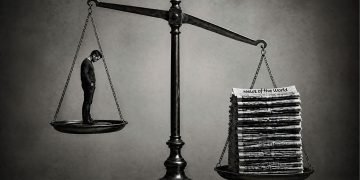
Trigger warnings on everything from fairytales to Shakespeare seems like an ever-growing avalanche, and I feel that they are unnecessary. Whether we need warnings about ‘the big bad wolf ’in Little Red Riding Hood, or protection from suicidal thoughts in Virginia Woolf’s Mrs Dalloway, seems in this day and age to be yet another contentious issue.
The articles I have read recently on the subject leave me feeling at best, very uncomfortable and at worst, seriously alarmed. They have also led me to consider that current practices may well be censorship by the back door. In the past a very small step, like banning one book, swiftly moved to banning others and even the incineration of ‘offending’ volumes.
As we live in an era of ‘taking offence’ where even a casual, careless remark can cause hurt feelings, perhaps escalating to suicidal thoughts and the possibility of thousands of pounds in compensation, you can understand my unease.
Dangerous fairy tales?
Richard Dawkins, speaking at the 2014 Cheltenham Science Festival, was reported to have said that “it was harmful to read fairytales to children because it instilled a false belief in the supernatural.” This sparked a debate on Twitter and readers of the article were asked to comment. The author Matt Haig posted: “Fairytales stir the imagination and imagination helps everything.”
However, Dawkins responded, denying he said that fairy stories were harmful to children, while admitting that he had once queried whether a “diet of supernatural magic spells might possibly have a detrimental effect on a child’s critical thinking.” He later said: “If you did inculcate into a child’s mind supernaturalism – that would be pernicious. The question is whether fairy stories actually do that and I’m now thinking they probably don’t. It could even be the reverse.”
What do you think? Did any of these stories seriously frighten you, your children or your grandchildren? In my experience most children have more sense than we credit them with. “It’s only a story. It’s not real.” This can be understood without watering down the content. Surely, we cannot argue with Albert Einstein who reportedly said: “If you want your children to be intelligent, read them fairytales. If you want your children to be more intelligent, read them more fairytales.”
I believe that, just as learning more than one language develops the mind, so living in more than one reality develops a better sense of the real world.
Censorship: offending texts
In 2023 the Times investigated university reading lists and reported: “Universities have started removing books from reading lists to protect students from ‘challenging’ content and have applied trigger warnings to more than 1,000 texts.”
Mark Twain’s Huckleberry Finn has almost disappeared from school libraries because of perceived racist language and distorted images of the American South. Why not retain the text and use it as a springboard to discuss changing attitudes and the reason for them?
I read Uncle Tom’s Cabin, an anti-slavery novel by Harriet Beecher Stowe, while I was still at primary school and the emotional impact stays with me to this day. It encouraged sympathy and empathy for the entrapped slaves, and also a partial understanding of why it was tolerated for so long. The Christian values and their comfort to some of the slaves opened another aspect, rarely examined.
No doubt, today’s trigger watchdogs would deem it unsuitable for an 11-year-old and I find it difficult to accept that this is necessary for 18-year-old adults.
Trigger warnings needed in changing times
However, I have learned through seventy plus years of reading ‘all kinds of everything’ that there are two, or even multiple sides to every question. Professor Michael Bugeja argues that trigger warnings are needed now more than ever, given the sexual assaults, racism and anxiety spiralling in university campuses.
On the one hand, trigger warnings prepare readers for content that might distress them and on the other, there is a danger that they are coddled and not fully prepared to face challenges. Disruptions and upsets are facts of life. Do we short-change students by deleting controversial content? Times have indeed changed and a mental health pandemic occurring in American universities and elsewhere is disturbing. With the added anxiety, inherent in widespread use of social media, machine learning and virtual and augmented reality, perhaps trigger warnings are becoming a necessary evil.
I do wonder, if there is a danger, that they too may add to this burden of anxiety that many young people buckle under. Is this really the most angst-ridden, doom-filled era of the twentieth century?
Academic freedom
Academic freedom may be under threat. At least some universities have recently agreed that “The presumption that students need to be protected, rather than challenged in a classroom is at once infantilising and anti-intellectual,” and “we do not cancel invited speakers because the topics might prove controversial.”
I never thought that I would find myself agreeing with Liz Truss who said: “real life does not come with a content warning. We can’t protect people from difficult ideas for their whole lives, nor should we try to.” James Cleverly, the then Education Secretary, said: “it is important we don’t ambush history.”
I think that universities have, understandably, a duty to protect the mental health of their students but they also have a duty to help them challenge themselves and to understand the world as it is. For my part, I’m not fully convinced that we live in the most stressful age. Post-war conditions were very bleak.
To escape into another world, age or culture in all kinds of texts remains for me a wonderful gateway to understanding and developing empathy.
As for trigger warnings, for me, the jury’s out.