


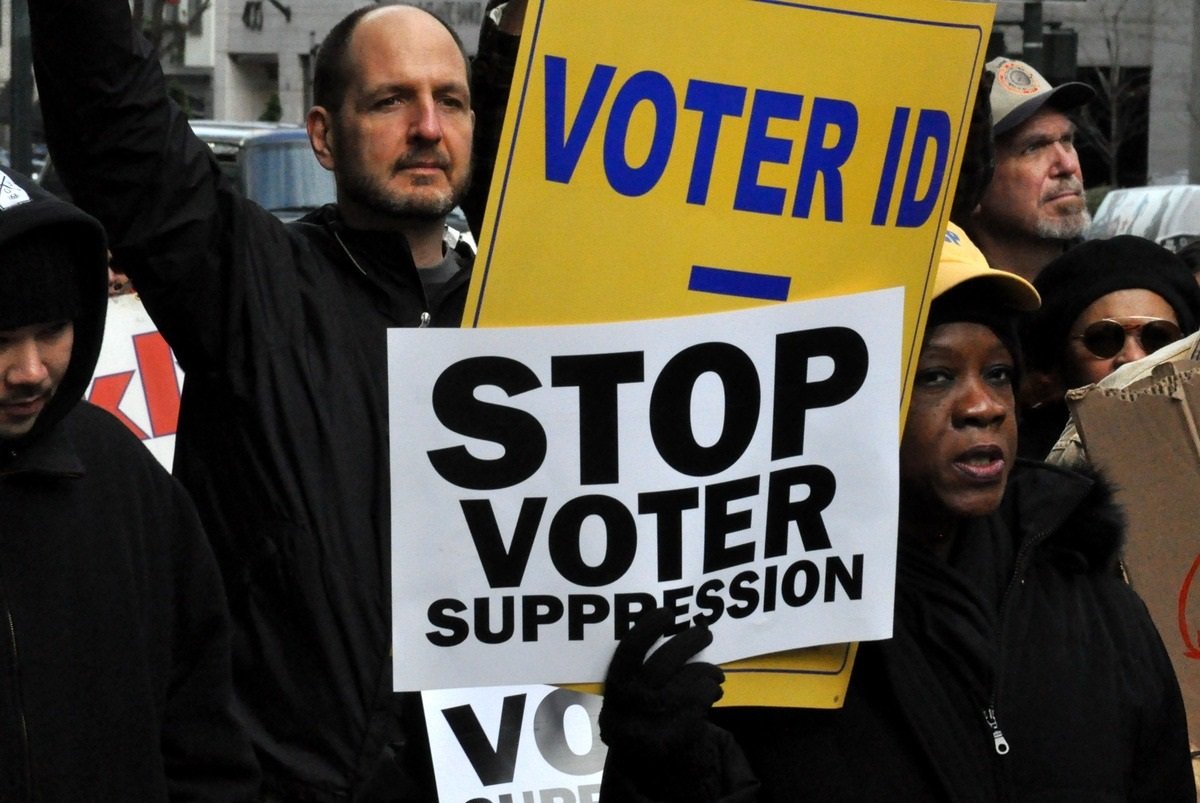
The UK government is deterring young voters by requiring them to bring photo ID to polling stations in order to vote.
Those who have just turned 18 may not yet possess such ID. The unfairness of the new restrictions was brought into sharp focus when it became clear that not all photo ID is equal. A young person’s travel pass is not accepted while an Older Person’s Bus Pass is.
Now, a registered voter with disabilities has begun a legal challenge against the government on the new changes.
New restrictions
When young voters turn 18, many are blindsided by the requirements they need to meet in order to vote. They feel they aren’t warned by anyone and end up getting turned away at the polling station.
I asked a dozen or so young people in Birmingham city centre how they felt about the new requirements and about voting in general.
Young couple Jason and Carla said they “don’t think a lot of young people know how to register”, showing how young voters are at a disadvantage right from the start. When told of the requirements, 20-year-old Melissa from Birmingham said: “What? Really? I never knew that, that’s not fair.”
For many, this will be enough for them to shrug off voting as a whole. When they are turned away at the polling station, they might not feel inclined to come back with some ID. The Electoral Commission survey of the May 2023 local elections revealed that the new photo ID requirements deterred 4% of younger voters, an equivalent of 14,000 people.
For the majority of those 14,000 voters, the issue was simply not having the correct ID to vote. For 1% of those rejected young voters, the issue was having to show the ID in the first place, which they disagreed with.

Lack of information
Other young people in the city centre made it clear that they are not inclined to vote simply because they lack information on voting candidates and the election in general.
Kelly said: “No, I probably won’t be voting. I wouldn’t even know what I’d be voting for.” This was a common opinion amongst our interviewees. Take Harry: “I’m not politically involved at the moment and I don’t know enough about it to vote. If I’m not educated enough then I won’t do it.”
This factor may be one of the main reasons that young people aren’t inclined to vote in the first place. Research from the British Election Study, collected last year, showed that only 49% of 18-24-year-olds were ‘likely to vote’, compared to 78% of voters aged over 66.
Another factor could be the options young voters have in front of them. Alex said: “You hardly want to vote for anyone, you’re voting for the lesser evil.” This opinion was shared by 22-year-old Oliver who said: “Seeing who is in charge right now does not inspire me to vote.”
Most of the responses collected in Birmingham also showed the extent to which voting is unpopular amongst younger people. Kelly said: “No, none of my friends would vote”, whilst Samantha said: “I might be the only one out of my friend group that votes.”
It should be equal rights
With an already-limited amount of people voting amongst the younger generation, deterring the ones that do vote is going to lower that number even further. People are starting to notice. Oliver said: “We shouldn’t have to have different IDs – that puts young people in disadvantage.” Kelly was of the same opinion as she said: “It should be equal rights shouldn’t it?”
A few actually agreed with the new ID restrictions. Harry said: “I’m fine with that because at our age I look 12, so I think it’s fair.”
Legal challenge
For at least one person, the matter is important enough to issue a legal challenge to the UK government. A registered voter with disabilities who was blocked from voting because of the new rule is being backed by legal watchdog Good Law Project (GLP).
Jo Maugham, the director of GLP, commented in an interview with The National, saying: “For no good reason and at enormous public expense, ministers are depriving people of their democratic right to vote […] Voter ID has been proven to be more likely to exclude the young, poor and ethnic minorities – it looks like a pretty blatant attempt at voter suppression by the Conservative Party.”
Everyone should have their say
For some younger people, the importance of an election keeps many of them playing by the government’s new rules, despite the restrictions. Samantha said: “Voting does matter, everyone should have their say in what their country chooses to do.”
Younger interviewees, such as 18-year-old Tom, supported that view by saying: “Yeah it will impact me in the long-run and if you don’t vote then you won’t see much change” whilst Oliver said: “It will definitely have an effect because different parties have different agendas.”


