


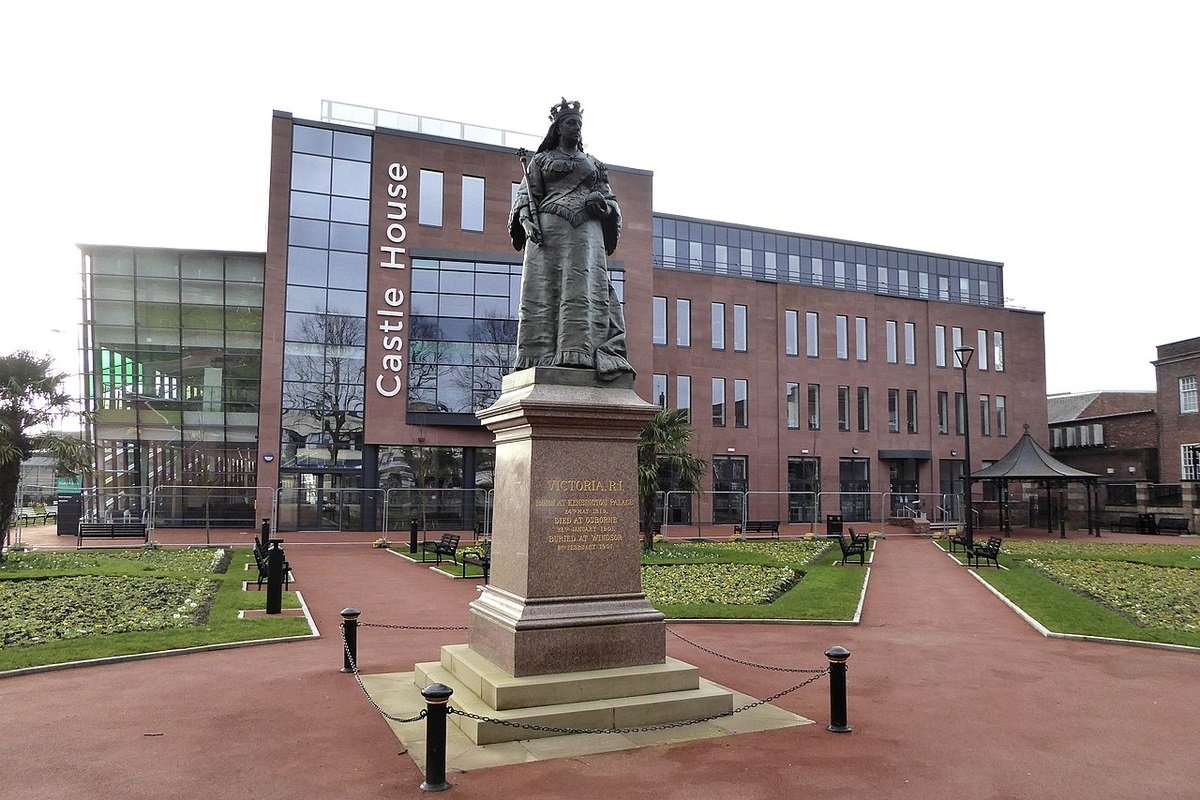
Newcastle-under-Lyme council has drawn the battle lines in its fight to protect the 800-year-old borough from being subsumed into a county-wide unitary authority.
The proposed reorganisation of local government, which would see the borough council disappear and be replaced by a larger unitary body including neighbouring Stoke-on-Trent became a major political issue at the start of this year.
At a meeting held in January the council leadership pledged to stand up for the borough’s historic independence and to work with the Staffordshire Leaders Board to develop an alternative to the government’s proposals. Speaking at the time the leader of Newcastle-under-Lyme Borough Council Simon Tagg said politicians from larger unitary authorities are “more remote from their communities”, adding that he doubted they would “prioritise the borough as we do now, which is less democratic and not what residents deserve”.
Council puts forward alternative plans for borough
A report presented to the full council meeting on 19 March set out the case against the creation of a unitary body. It made the case that the current ‘two tier’ system of borough and county councils is delivering “good cost-effective services, accountable at local level”.
Tagg said he hadn’t “heard any argument which shows how forced change from the current position will improve residents’ lives and it’s illogical that they should be forced to accept something which lowers current levels of service and performance”.
The report outlines several alternative plans including the creation of a single authority in association with Staffordshire Moorlands Council. It also suggests as a possibility the creation of a West Staffordshire single authority broadly based on the M6 corridor.
The report makes clear that the borough council do not favour the creation of either a North Staffordshire Unitary Authority combining Staffordshire Moorlands and Stoke-on-Trent, or a similar authority based on the existing Staffordshire County Council footprint.

Pressure for local government reorganisation criticised
In a report launched at their annual conference the District Councils Network (DCN) criticised government plans to reorganise local government as a “short term cost saving exercise”. The report goes on to say that “at worst it will be a hugely costly and disruptive process that will simply create larger versions of semi-functional or dysfunctional arrangements that aren’t delivering for those that need it the most or for the nation as a whole”.
In the report the DCN argue that the rapid timescale has impeded the “bandwidth” of councils to come up with ambitious proposals and this could result in an outcome that is “driven by risk aversion rather than ambition”.
The government expects reorganisation proposals for the new unitary authorities to be up and running by 2028.
Council considers alternative options
Newcastle Borough Council is positive towards the creation of a Strategic Authority including Staffordshire and Stoke-on-Trent to cover areas including transport, regeneration and responding to climate change.
This, Tagg said, is an option that “has merit” because it “has potential to bring powers and funding from London”.
A Strategic Authority would not be responsible for delivering day-to-day services and there was not, at a local level, either demand or a convincing argument, he went on to say, to “rip up the existing system of local government in favour of giving residents something less than they already have”.
The council does not, however, support such an authority, were it to come into being, being led by an elected mayor.
Special council meeting invites Minister of State
A special meeting of the full council held on 21March approved the report. Council leader Tagg has also declined to sign an interim submission on reorganisation made by the Staffordshire Leader’s Board. The partnership of Stoke-on-Trent City Council, Staffordshire County Council and eight others has sent proposals to Minister of State for Local Government Jim McMahon to create either a single unitary authority on the current country council footprint, leaving Stoke-on-Trent’s position unchanged, or two separate unitary authorities serving respectively Stoke, Newcastle and Staffordshire Moorlands, and East Staffordshire, Litchfield, Cannock Chase, Tamworth and South Staffordshire.
Tagg has invited the minister to visit Newcastle to see how the current two-tier system is benefiting residents. He said: “One size does not fit all, and I think the minister ought to see for himself what is actually happening here.”
Among the evidence he will be showing the minister, if he visits, will be the £85 million developments at The Rycroft, Astley Place and the former Midway multi-storey car park. All of these were made possible due to Newcastle being “a borough council rooted in our community … focused on making Newcastle town centre a better place for people to live, work and enjoy our shops, pubs, cafes and restaurants”.
The council did not, Tagg said, have a closed mind regarding reorganisation and would continue to review the available evidence. They did believe it was “only right that we make the arguments on behalf of the residents of Newcastle-under-Lyme and insist that if there is to be change, they are given a vote on their future in a local referendum”.


